Oxford’s Two Minutes Hate against gender-critical lecturers
University officers have supported trans activists’ attempts to shut down lectures on sex and the law.
Want unlimited, ad-free access? Become a spiked supporter.
Oxford University appears to be modelling its approach to campus free speech on Nineteen Eighty-Four. Senior administrators seem particularly taken with Orwell’s depiction of the Two Minutes Hate, whereby citizens are encouraged to engage in a ritual public denunciation of wrongthinkers.
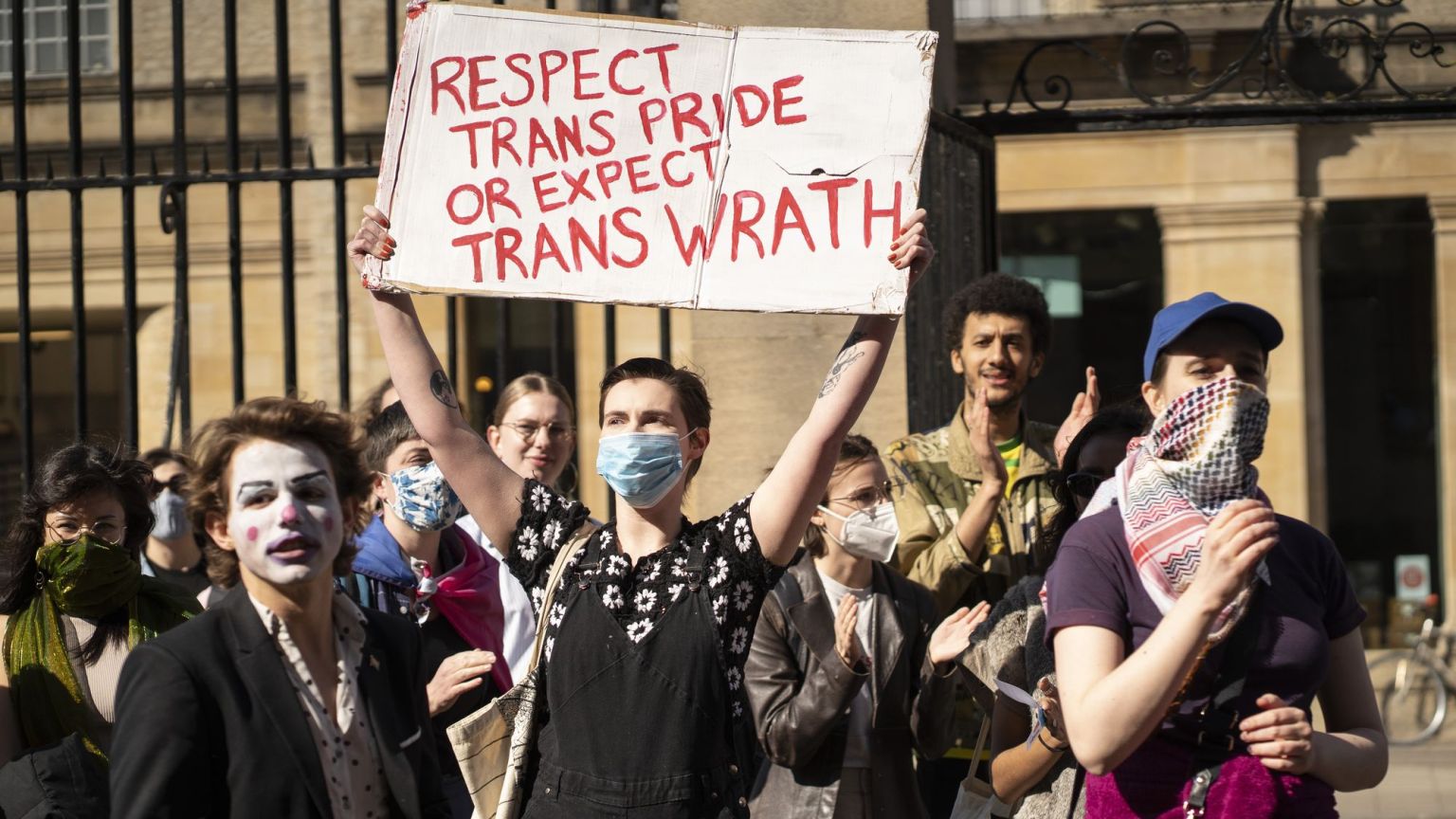
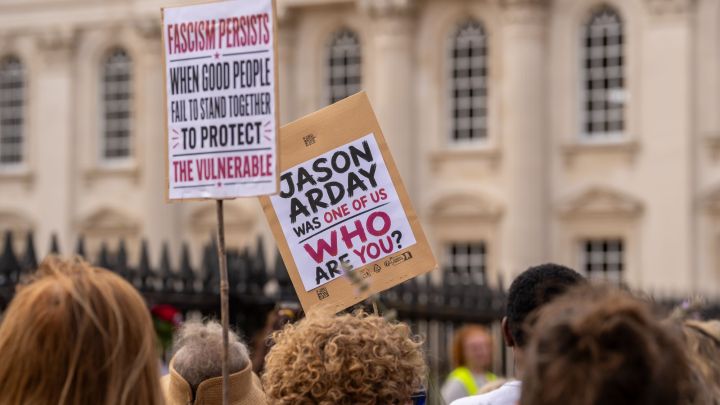
How else to explain the university’s response to censorial students attempting to cancel someone who dared to think differently? The latest campus hissy fit began in May when a lecture series by Dr Michael Foran, an associate professor of law at Keble College, was repeatedly disrupted by trans activists.
Foran’s crime? His work was cited in the UK Supreme Court’s ruling last year, which stated that, for the purposes of the Equality Act 2010, ‘woman’ and ‘sex’ refer to biological sex – a ruling, of course, that has enraged trans activists, including those at Oxford.
And so before the first of Foran’s four planned lectures, based on his recent book, Sex, Gender Identity and the Law, trans activists plonked themselves in front of Foran’s lectern. They then told the audience that he was a ‘bigot’ who ‘masks his transphobia behind a thin veneer of academia’, before urging them to walk out and refuse to platform him.
Having had enough of this sort of thing over the years, student attendees stayed put before lodging a formal complaint with the proctors – senior officers responsible for enforcing the university rules – about the disruptive and intimidating character of the protest. According to The Times, one attendee said the complaint was ‘a call to uphold academic freedom at Oxford’.
That complaint was dismissed and by the second event, which took place on 5 June, the proctors clearly knew disruption might recur and escalate. So it is all the more significant that when the protesters duly returned, the whole unedifying spectacle took place not just with the proctors’ approval, but with proctors actually in attendance.
Perhaps unsurprisingly, Foran cancelled the remaining lectures. Some students who attended the lectures later faced online bullying, after photographs taken during the protest were shared online and activists asked for help identifying them.

The obvious course, once protesters had already denounced the speaker and pressured attendees to leave, was to keep any further protest outside the lecture hall, with security in place, so the lecture could proceed. But that is not what the university did. It elevated the right to protest over all free-speech rights. As a result, censorship triumphed over academic freedom and open inquiry.
After Foran announced the cancellation of his lectures, more than 100 academics – including evolutionary biologist Richard Dawkins – wrote a letter to Oxford that was highly critical of the proctors’ approach. ‘The proctors have enabled the exercise of a heckler’s veto’, the letter stated. The response, issued by a university spokeswoman, showed no indication that Oxford’s authorities thought the proctors had done anything wrong.
This raises the unsettling question of whether life at Oxford is beginning to imitate art. Do the proctors really want to proceduralise Nineteen Eighty-Four? Is a Two Minutes Hate acceptable, provided it is properly facilitated and brought to a prompt conclusion? And will Foran’s latest monograph be hurled down the memory hole, with security shortly thereafter escorting him to his new office in Room 101?
The test will come now that Oxford, following concerted pressure from concerned academics, has announced that Foran’s lectures will be rescheduled. That’s a welcome decision, but the university still has not said that what happened last time should not have been allowed, while the proctors are refusing to say whether they would again permit an in-lecture protest.
Let’s hope Oxford gets back to basics – and enforces the law – because its current approach is clearly wrong. It inescapably invites political bias into decisions about which causes deserve the indulgence of an in-lecture-hall protest, and which campaigners can be left out in the cold.
Would the same proctors who worked with trans activists in this case permit undergraduate women’s-rights campaigners to interrupt a gender-identity theorist’s lecture, denounce their views on trans inclusion in women’s prisons as misogynistic and urge students to leave rather than engage with the arguments? One suspects not.
The university is, of course, free to go on record as saying that this, too, would be perfectly acceptable. But any proles out there waiting for Big Brother’s – sorry, the proctors’ – voice to blare across the telescreen with an announcement to that effect may be waiting some time.
Freddie Attenborough is director of research for the Committee for Academic Freedom.
You’ve hit your monthly free article limit.
Support spiked and get unlimited access.
Support spiked and get unlimited access
spiked is funded by readers like you. Only 0.1% of regular readers currently support us. If just 1% did, we could grow our team and step up the fight for free speech and democracy.
Become a spiked supporter and enjoy unlimited, ad-free access, bonus content and exclusive events – while helping to keep independent journalism alive.
Monthly support makes the biggest difference. Thank you.
Comments
Want to join the conversation?
Only spiked supporters and patrons, who donate regularly to us, can comment on our articles.