Must Durham’s miners be forced to celebrate Palestine?
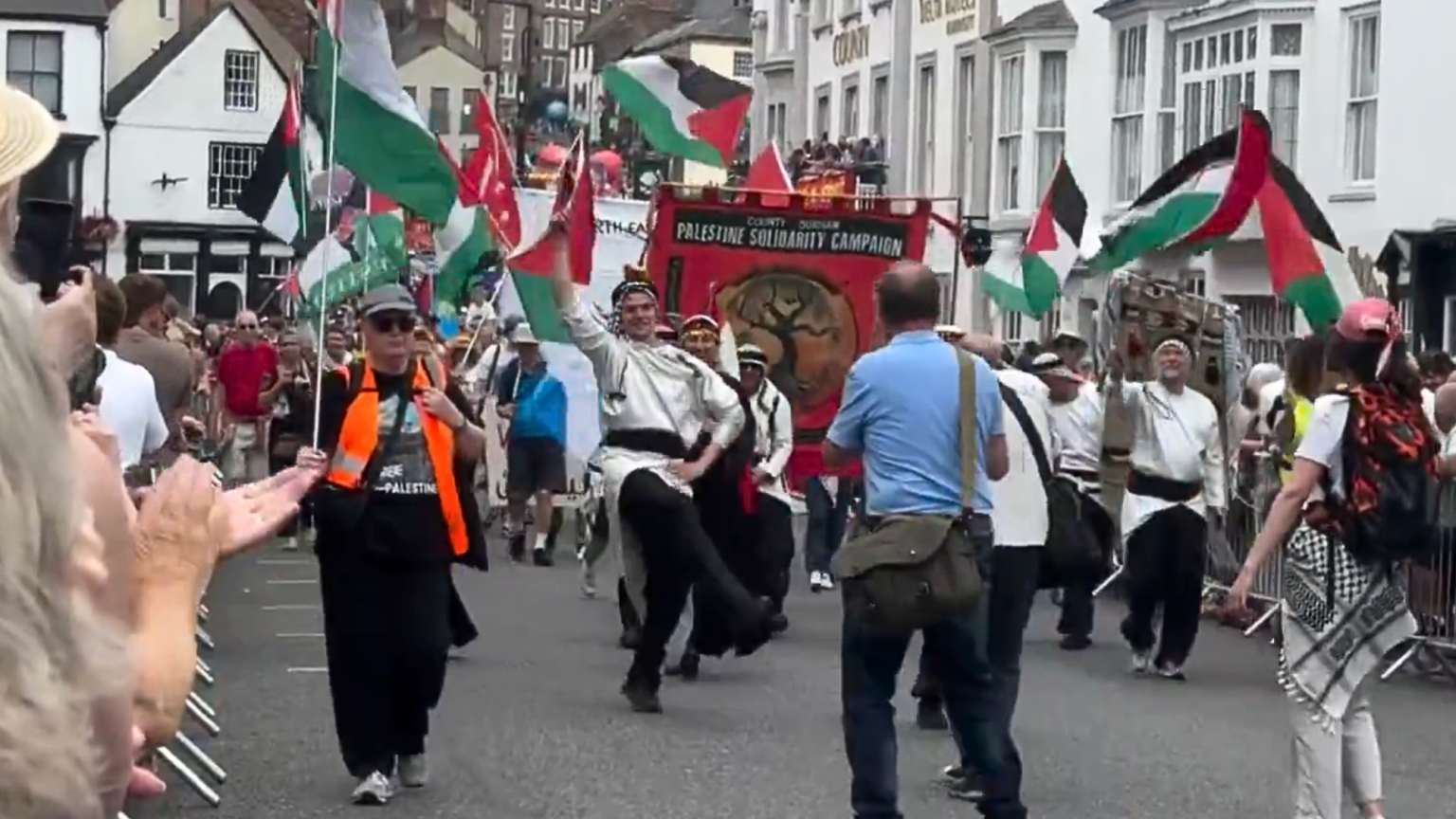
The ‘Free Palestine’ float at the Durham Miners’ Gala was straight out of a Monty Python sketch.
Want unlimited, ad-free access? Become a spiked supporter.
The Durham Miners’ Gala – ‘the big meeting’, as locals still call it – took place last week. Once, every coalfield had its gala. Now Durham’s is the last great survivor. But survival is not the same as relevance.
In recent years, the question hanging over the ‘big meeting’ has become harder to avoid: what is it for, and who does it now belong to? That question became sharper still after County Durham, long impregnable Labour country, turned into something much closer to a Reform UK stronghold in last year’s local elections.
The gala itself remains organised around a politics that belongs to another century. It is caught between three worlds: the culture of the old industrial working class, the socialist politics of the 20th century and the activist liberalism of the contemporary left. Add to that the visible support for Reform among the families and descendants of Durham colliers, and the contradiction becomes impossible to ignore. The big meeting can no longer pretend that these tensions are merely background noise.
Over the past few years, the Gala has become less a living expression of working-class politics and more a stage for the narrow concerns of the Corbynista activist class. A clip from this year’s event made the point brutally. The ‘Palestine Bloc’ – around 30 (mostly white) activists carrying Palestine flags and wearing the keffiyeh uniform of the modern protester – moved through Durham behind a few dancers in traditional Palestinian dress. They shouted ‘free, free Palestine’. Some in the crowd clapped. Others booed. John Cleese posted a video of it on X, with the observation that it would not be out of place in a Monty Python sketch. He’s right.
This wasn’t the first time the gala has embarrassed itself. The flashpoint last year was the invitation to Husam Zomlot, the Palestinian ambassador to the UK. It seems that every year the gala is dragged into another controversy because the activist left insists on making it speak the language of identity politics and middle-class luxury beliefs. As a result, the working class has been turned into a costume, a backdrop, a set of banners and brass bands to lend moral weight to causes that often have little to do with the people whose history is being borrowed.
I know what these galas meant because I grew up with them. As a child, I went with my family to the local gala at Berry Hill in Mansfield. It was a great occasion, not a seminar in radical theory. Families from across the Nottinghamshire coalfields met, talked, drank, listened to brass bands and watched the banners pass. It was social, cultural and political all at once.
Yes, there were speeches from trade-union leaders and Labour MPs. But coalfield Labour was not the same thing as metropolitan leftism. Mining communities were often Labour by loyalty and history, but conservative in instinct: rooted in family, place, work, respectability and belonging. The banners could be radical, with muscular miners, Keir Hardie, sometimes Marx and Lenin, and slogans such as ‘Unity is Strength’ and ‘Our Future We Build From the Past’. But the life around them was ordinary, local and deeply communal. There were Coal Queens, baking competitions and vegetable competitions, with miners spending the year cultivating giant onions and leeks.

That was not an embarrassment. It was part of the texture of working-class life. The politics were housing, healthcare, education, jobs, wages, family and the cost of living. They were not abstract performances staged for the approval of graduate activists.
That is why this year’s gala felt less like a celebration than a warning. The British left still wants the imagery of the industrial working class, but it no longer knows how to speak to the people who inherited it. Their politics are too awkward: patriotic, communal, anti-authoritarian, loyal to family and place, suspicious of elites, and often far less liberal than the people who claim to champion them.
The ‘neu-left’, as I call them, want the banners, the brass bands, the flat caps and the moral inheritance, but not the actual working class, with all its complications. If one image captures the absurdity of the contemporary left, it is this: Palestine activists marching through Durham, and Angela Rayner looking down from a balcony like visiting royalty, the crowd clapping loudly enough to try to drown out the boos, and Reform sitting in the council offices.
Lisa McKenzie is a working-class academic.
You’ve hit your monthly free article limit.
Support spiked and get unlimited access.
Support spiked and get unlimited access
spiked is funded by readers like you. Only 0.1% of regular readers currently support us. If just 1% did, we could grow our team and step up the fight for free speech and democracy.
Become a spiked supporter and enjoy unlimited, ad-free access, bonus content and exclusive events – while helping to keep independent journalism alive.
Monthly support makes the biggest difference. Thank you.


Comments
Want to join the conversation?
Only spiked supporters and patrons, who donate regularly to us, can comment on our articles.