Burnham’s unbuttoned premiership is not a good look
The PM’s insistence on dressing down betrays a casual indifference to the duties of high office.
Want unlimited, ad-free access? Become a spiked supporter.
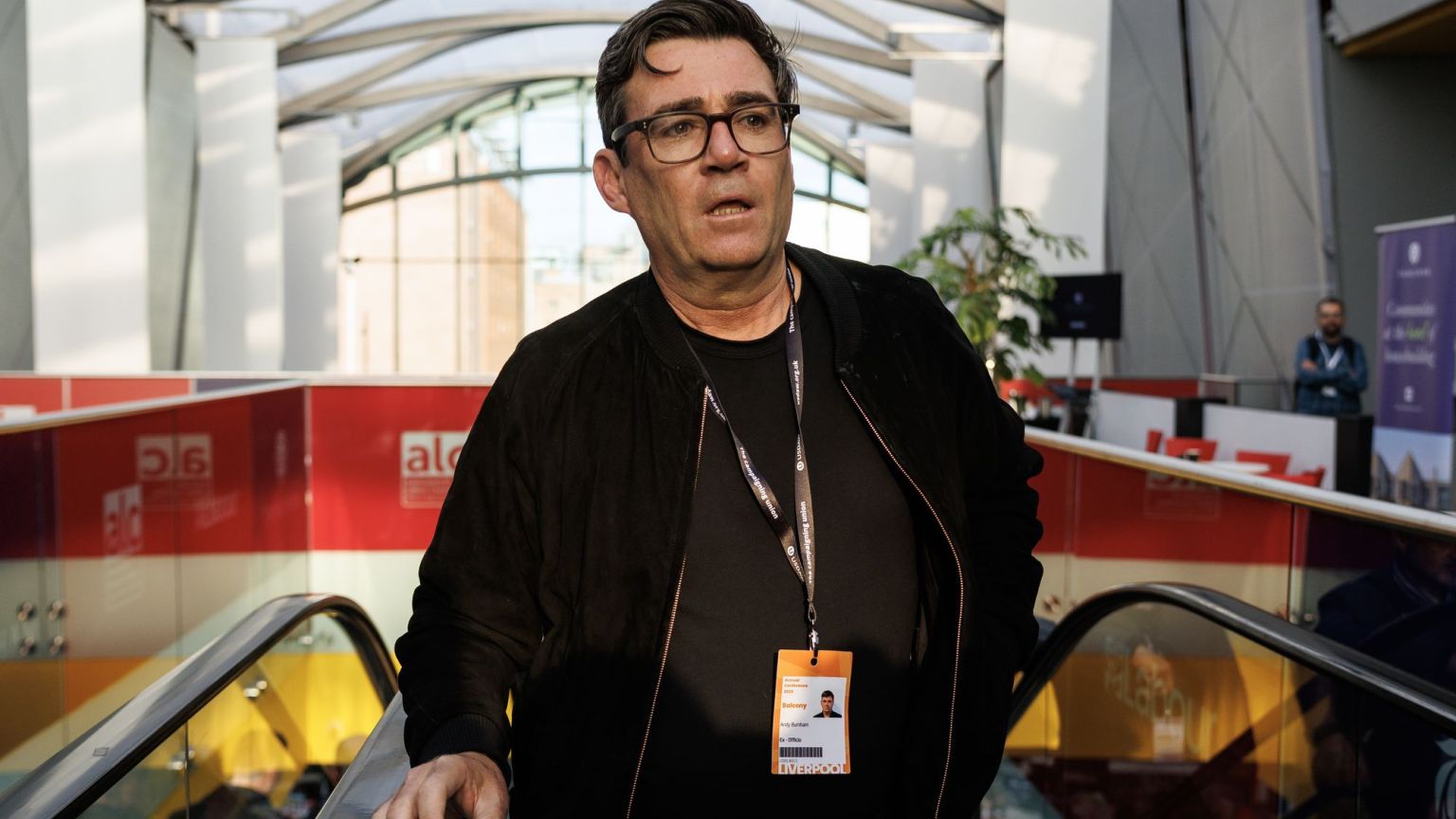
Andy Burnham has pledged to do politics differently. He certainly wants to change the look of politics, if not necessarily the substance. In his inaugural speech yesterday, out went the official lectern. So too, it seems, will the protocol of formal dress normally associated with high office. Burnham let it be known last week that he intends to wear a suit and tie only in the House of Commons.
So, we face the grim prospect of the UK prime minister conducting affairs of state in ‘figure-hugging’ black t-shirts, jogging bottoms and expensive trainers, as though permanently recovering from a rave in Manchester’s Northern Quarter. The tieless days of Tony Blair and Alastair Campbell may soon come to look positively Edwardian. Whether nose piercings and neck tattoos make an appearance in cabinet meetings remains to be seen.
Does any of this really matter? Isn’t attachment to the suited-and-booted look merely a fogeyish affectation, the last refuge of people who still iron their handkerchiefs?
Not really. Clothes are never just clothes. They are statements of intent. They tell us how an institution sees itself and how seriously it expects to be taken. Burnham’s determination to import work-from-home aesthetics into the highest offices of state is a strangely adolescent gesture. The office becomes an extension of the sofa. Government becomes just another Microsoft Teams meeting.
For centuries, the workplace has deliberately distinguished itself from the home. The transition from private to public life was symbolised by changing how one dressed. We still understand this instinctively. We put schoolchildren into uniforms not because wearing blazers improves their maths skills, but because uniform marks the transition from the private world of the family into the public world of shared rules, responsibilities and expectations. Dressing differently encourages behaving differently.
That principle once applied even more strongly to high office. Putting on the suit, the gown or the uniform was never simply about appearances. It was a ritual acknowledgement that the office mattered more than the individual occupying it. Ministers were expected to adapt themselves to the institution rather than expecting the institution to adapt to their personal brand.
Burnham’s declaration implies the opposite. The message is that public office should accommodate the lifestyle preferences of those who hold it. It reflects the broader cultural assumption that institutions should become more ‘authentic’, more casual and more like us, rather than expecting us to rise to their standards. It is a curious inversion. The prime minister is no longer expected to look like the prime minister – instead, he is expected to look like everybody else.
Dress codes have always signalled seriousness. Judges still wear robes. Military officers still wear uniforms. Diplomats still dress with painstaking formality because clothes communicate respect – for the occasion, for the office and for those with whom they are dealing.
Nobody imagines that a well-cut suit makes someone more competent. But it does say that the occasion deserves more than whatever happened to be hanging over the back of the chair. Winston Churchill famously wore his informal ‘siren suit’ during the Blitz without diminishing his authority. But Churchill understood that this exceptional clothing reflected exceptional circumstances.
Dress also marked the divide between the old Britain of duty and the new Britain of perpetual youthfulness. Tony Blair and Alastair Campbell understood perfectly well that loosening the tie was never just about comfort. It symbolised a broader rejection of the formality and restraint of the pre-New Labour world. Politics would become more informal, more conversational, more relaxed – and, inevitably, more personal.
Since then, every institution has been encouraged to ‘dress down’, flatten hierarchies and blur distinctions. Universities resemble tech start-ups. Bank managers look like marketing executives. Senior civil servants often dress like they are on their way to Glastonbury. The assumption is always that informality breeds creativity, even though it more often breeds familiarity and lowered expectations.
There is, after all, a reason why nobody wants to see airline pilots flying in hoodies or surgeons operating in cargo shorts. Uniforms and conventions reassure us because they communicate professionalism before a word has been spoken. We instinctively associate standards of appearance with standards of conduct, even if we know intellectually that the relationship is imperfect.
None of this means politicians need to resemble Victorian undertakers or City solicitors. But symbols matter because politics itself runs on symbols. Ceremonies, traditions, robes, despatch boxes, Black Rod and yes, even suits and ties, all remind us that democratic government is larger than the personalities temporarily passing through it.
Andy Burnham’s wardrobe may seem a trivial matter. Yet it reflects a deeper instinct of contemporary politics. The irony is that, in trying so hard to look ordinary, politicians risk making the extraordinary responsibilities of government appear ordinary, too.
Keir Starmer proved that a suit and tie are no guarantee of good government. But it is difficult to believe Britain will be better governed by a prime minister who looks as though he’s just nipped out of PureGym.
Neil Davenport is a writer based in London.
You’ve hit your monthly free article limit.
Support spiked and get unlimited access.
Support spiked and get unlimited access
spiked is funded by readers like you. Only 0.1% of regular readers currently support us. If just 1% did, we could grow our team and step up the fight for free speech and democracy.
Become a spiked supporter and enjoy unlimited, ad-free access, bonus content and exclusive events – while helping to keep independent journalism alive.
Monthly support makes the biggest difference. Thank you.



Comments
Want to join the conversation?
Only spiked supporters and patrons, who donate regularly to us, can comment on our articles.