France may be on fire, but ‘the world’ is not
The images from Bordeaux are terrifying, but the data simply do not support the climate-alarmist narrative.
Want unlimited, ad-free access? Become a spiked supporter.
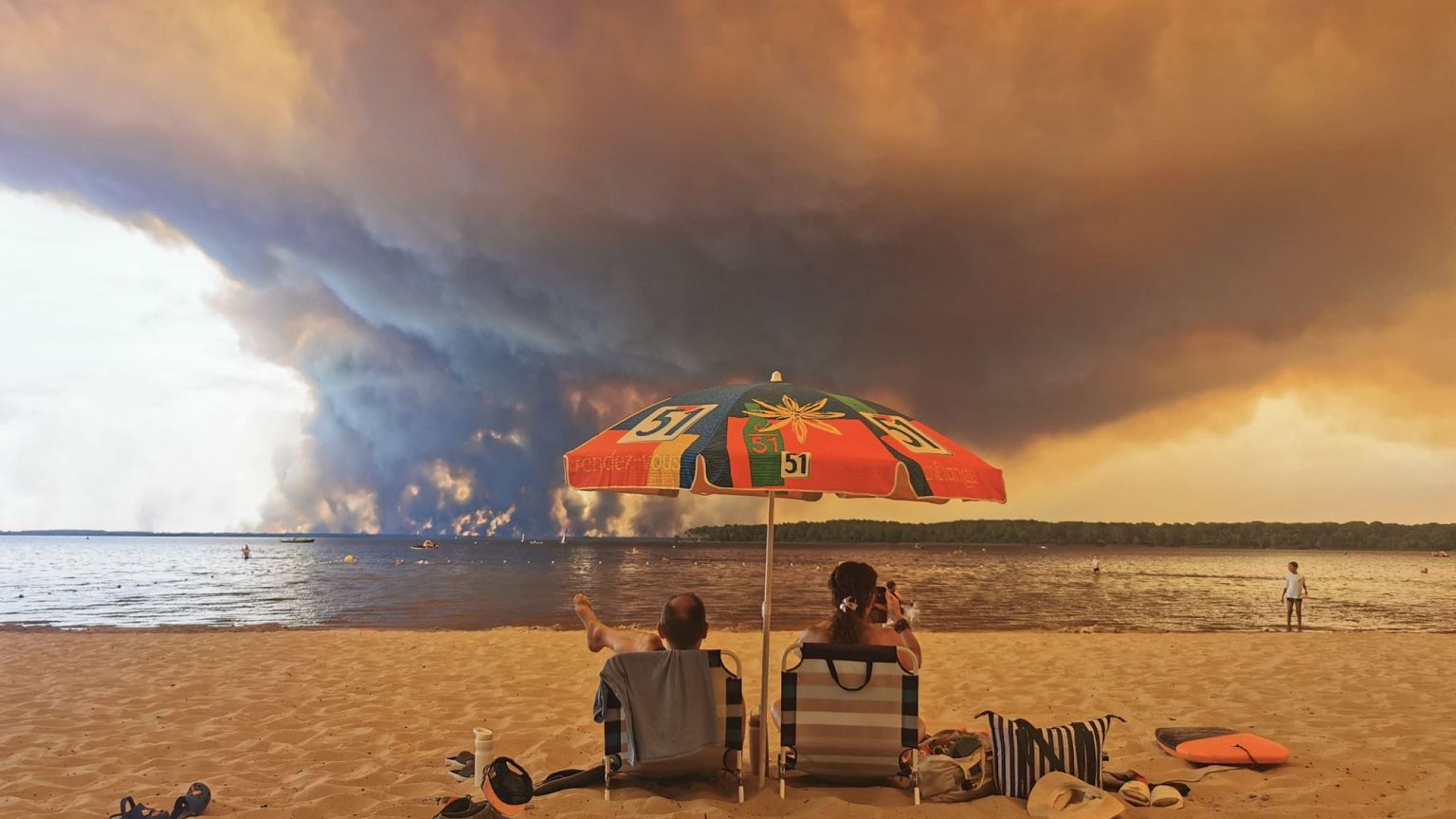
The world is on fire. And now we don’t just have Greta Thunberg to tell us so; we can just look at the ‘apocalyptic’ images from Bordeaux and see for ourselves. That will keep the ‘deniers’ quiet, have them shuffling from foot to foot as they realise just how foolish they have been.
That, at any rate, is what we are supposed to believe. Except that it is undermined by a simple fact: up until this point in the year 2026 has been one of the least-bad years for wildfires for over a decade. This is true in Europe, and globally, too.
This comes not from some dodgy denier website sponsored by an oil company but from the Global Wildfire Information System run by NASA, the European Space Agency, King’s College London and many national scientific bodies. The data are there, free, for anyone to look up should they be sufficiently interested to do so. It is just that a few climate activists, politicians and others seem to prefer scaremongering derived from some alluring press photos. They tell us to ‘listen to the scientists’, big up every piece of worst-case climate modelling. But they can’t actually be bothered with real-world data that doesn’t conform to their chosen narrative.
This is what the data say. France has indeed had an especially bad year for wildfires. Up until 22 July, a cumulative 85,000 hectares of land had been burned. In an average year during the period 2012-25, 30,000 hectares had been burned up until this date.
Spain is having a bad year, too. Up until 22 July, 142,000 hectares had burned, compared with an average of 75,000 up to this point of the year. Spain has had worse years, though: in the worst year during the period of 2012-25, 235,000 hectares had burned by this point in the year.
However, across Europe as a whole, 2026 has been the least-bad year recorded since 2012. Up until 22 July, 3.6million hectares had burned, compared with 11.3million at this point in an average year. The previous lowest total up until 22 July was 6.7million hectares.
The same, remarkably, is true of every continent. In Africa in 2026, 57.8million hectares had been burned up until 22 July compared with a 2012-25 average of 103.9million. In the Americas, the corresponding figures are 13.9million and 25.9million. In Asia, they are 19.6million and 27.9million and in Oceania 11.1million and 13.5million. Is that really a world ‘on fire’? It is, rather, a world where the flames are steadily being extinguished.

None of this, of course, will come as any consolation to those whose homes are caught in the path of the flame in France. For them, this may well seem like an unprecedented disaster. It comes across as all the more unusual because French authorities are normally especially effective at controlling and putting out wildfires. I learned this last summer while I was on the final stretch of walking the length of the French Alps. A few miles ahead of me, smoke was rising from the trees on a ridge where my planned route took me. As everything was tinder-dry, I feared the worst. Yet by the time I reached the site of the flames, the sapeurs-pompiers had put them out, leaving a singed hillside. But they hadn’t just driven off: as always on these occasions, they were going to hang around for hours to smother any revival of the fire.
Ironically, being good at putting out fires is, ultimately, part of the problem. Wildfires are part of natural forest management and always have been. There are some species of plant that will only germinate in the aftermath of a fire, when competition from other plants is at its weakest. Prevent the small fires, however, and fuel builds up on the forest floor. Eventually, when you do get a fire that outruns the firefighters, it will become an especially big fire.
This is what has happened in the US. The area of land burned plummeted rapidly during the 1940s and 1950s as fire services became better at extinguishing them. From the 1980s, it began to rise again, though it is still far less than in the 1920s. But when fires do break out, they tend to be larger. The big fires that threatened Los Angeles in January 2025, like those threatening Bordeaux now, are a product of what Valerie Trouet, professor of dendrochronology at the University of Arizona, has described as a century of ‘fire deficit’.
So yes, there is a man-made element of the crisis in south-west France. But it isn’t the one activists want us to believe: climate change. It is unwise forest management. If we regularly burned forests with controlled burning, or otherwise removed the deadwood that accumulates when forests don’t burn, we wouldn’t have such large and threatening fires.

Ross Clark is the author of Not Zero: How an Irrational Target Will Impoverish You, Help China (and Won’t Even Save the Planet). He also writes the Substack, Ross on Why.
You’ve hit your monthly free article limit.
Support spiked and get unlimited access.
Support spiked and get unlimited access
spiked is funded by readers like you. Only 0.1% of regular readers currently support us. If just 1% did, we could grow our team and step up the fight for free speech and democracy.
Become a spiked supporter and enjoy unlimited, ad-free access, bonus content and exclusive events – while helping to keep independent journalism alive.
Monthly support makes the biggest difference. Thank you.






Comments
Want to join the conversation?
Only spiked supporters and patrons, who donate regularly to us, can comment on our articles.