The two-tier policing of BLM Britain
Police were explicitly instructed not to arrest violent criminals, as it might ‘trigger’ community unrest.

Want unlimited, ad-free access? Become a spiked supporter.
The term ‘two-tier policing’ may have only gained traction in the past few years, but the practice has been well established for some time. A newly leaked police memo, issued at the height of the Black Lives Matter protests in the summer of 2020, reveals that race played a major factor in the police’s response to the protests.
In a sentiment that now feels painfully familiar, police forces across England and Wales were told not to arrest potential criminals, lest the actions of the authorities ‘increase tensions’ with the ‘BAME (black, Asian and minority-ethnic) community’. According to the directive issued by the National Police Coordination Centre (NPoCC), and uncovered by investigative journalist Steven Edginton, arresting protesters for offences such as assaulting police or criminal damage could be a ‘trigger point’ that could lead to more violent unrest.
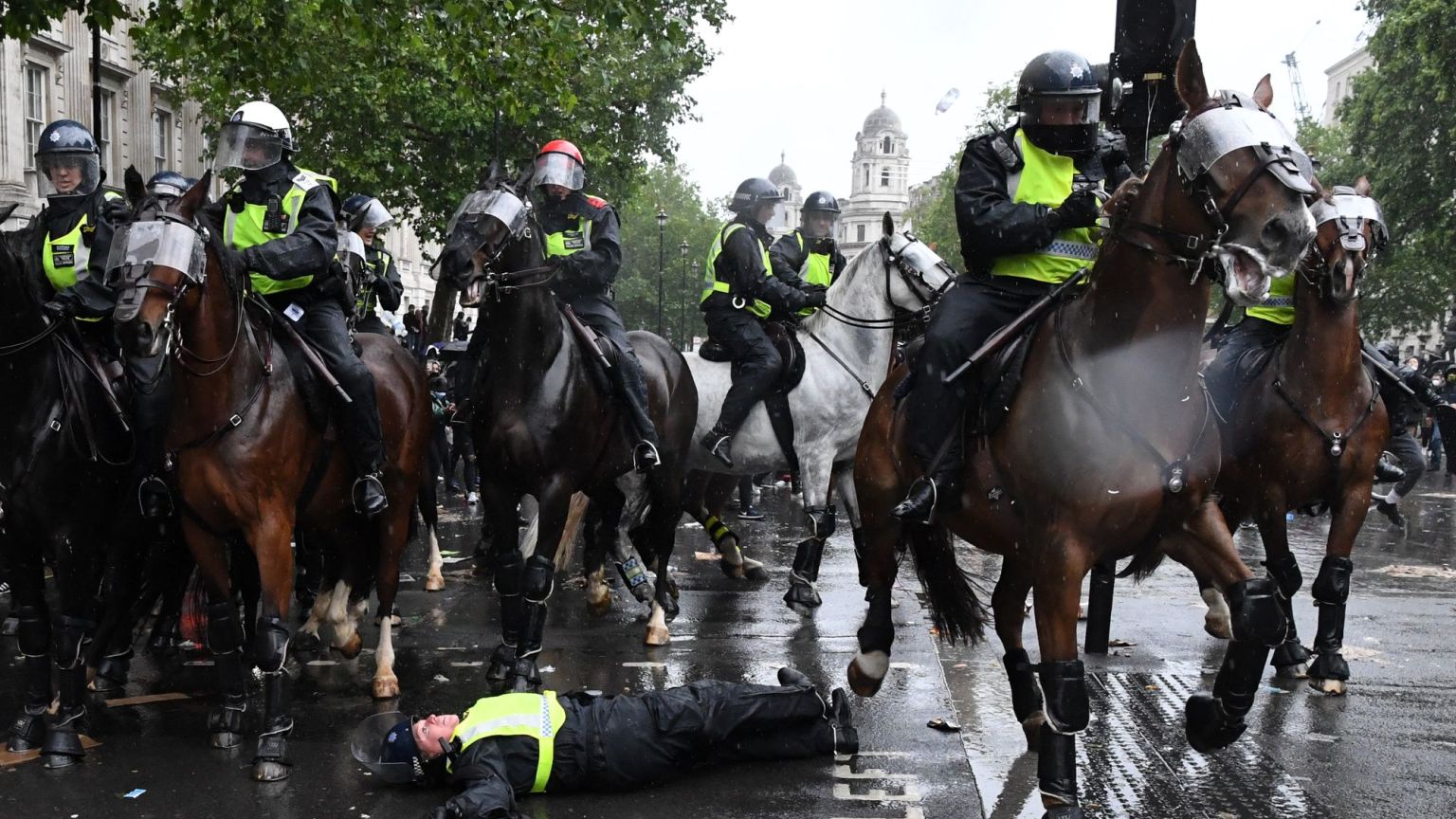
You might recall that the police at these protests had their hands full – to put it mildly. In response to the murder of George Floyd by Minneapolis policeman Derek Chauvin in May 2020, the Black Lives Matter movement spread from the US to the UK. London was the scene of some of the biggest protests, which police allowed to take place despite Covid social-distancing restrictions being in place at the time. Significant damage to public property was caused, most notably the desecration of Winston Churchill’s statue in Parliament Square. More than 60 officers were injured in the unrest, too.
The most seriously hurt of these was PC Nicky Vernon, who suffered a fractured spine and punctured lung when she was thrown off her horse after protesters directed fireworks and flares in her direction. Faithful to the NPoCC directive, no one was charged as a result of her injuries.
Other protesters at the time were not treated so leniently. In August 2020, an anti-lockdown protest was held in central London. Piers Corbyn was fined £10,000 for his role in organising the demo and speaking to those who had gathered. Clearly, the police were acting on two sets of standards: injuring officers was fine, so long as it was done in pursuit of the ‘right’ cause, while speaking at a rally was a criminal offence if it advanced the ‘wrong’ one.
The murder of Henry Nowak in Southampton last year, and the police’s inhumane response to his injuries, remind us just how dangerous two-tier policing can be. Officers at the scene would have been operating according to the Police Anti-Racism Commitment, published by the National Police Chiefs’ Council in March 2025, which explicitly instructs police to treat members of the public differently, according to their race. Anti-racism, it says, ‘does not mean treating everyone “the same” or being “colour-blind” (racial equality)’.
We didn’t need these documents to ‘prove’ that two-tier policing is a reality, of course. Time and again, the police, prosecutors and the courts have responded with extreme harshness to unfavoured groups committing minor offences, and with baffling leniency to even violent crimes when the perpetrator comes from a ‘protected’ group. You can now predict with astonishing accuracy how police will respond to a protest, a riot or a speechcrime if you know the race or political leanings of those involved.

If the police are to ever fulfill their duty to protect members of the public, without fear or favour, then they must exorcise the poison of woke racial identitarianism.
Hugo Timms is a staff writer at spiked.
You’ve hit your monthly free article limit.
Support spiked and get unlimited access.
Support spiked and get unlimited access
spiked is funded by readers like you. Only 0.1% of regular readers currently support us. If just 1% did, we could grow our team and step up the fight for free speech and democracy.
Become a spiked supporter and enjoy unlimited, ad-free access, bonus content and exclusive events – while helping to keep independent journalism alive.
Monthly support makes the biggest difference. Thank you.


Comments
Want to join the conversation?
Only spiked supporters and patrons, who donate regularly to us, can comment on our articles.